1. What Is Bitcoin Mining?
2. Why Bitcoin Mining Matters
3. How does the Bitcoin Mining Process Work
4. The Evolution of Bitcoin Mining
5. How Bitcoin Miners Earn Money
6. Bitcoin Halving and the 21 million Supply
7. The Future of Bitcoin Mining
Conclusion

 Part of a series
Bitcoin mining is the process of using computational power to participate in Proof of Work. Miners construct candidate blocks containing transactions and repeatedly calculate hashes in an attempt to produce an output that satisfies the network's current difficulty target.
The first miner to find a valid block broadcasts it to the network. Other nodes independently verify the block. If valid, it becomes part of the blockchain. The successful miner receives the block reward, consisting of the block subsidy and transaction fees.
Bitcoin has no central bank, central server, or administrator deciding which transactions are valid. Instead, it relies on a distributed network. Mining provides the mechanism through which participants compete to add blocks to the blockchain and makes rewriting transaction history economically expensive.
Understanding mining is therefore essential to understanding Bitcoin itself. Mining connects transaction processing, network security, and the original issuance of new Bitcoin.
Step 1: Users broadcast signed Bitcoin transactions to the peer-to-peer network.
Step 2: Miners select valid transactions and assemble a candidate block.
Step 3: Mining hardware repeatedly performs SHA-256 hashing while changing block values such as the nonce.
Step 4: A miner eventually discovers a hash below the network's required target.
Step 5: Other nodes independently verify the block and accept it if it follows consensus rules.
Step 6: The successful miner receives the block subsidy and transaction fees, and the competition begins again.
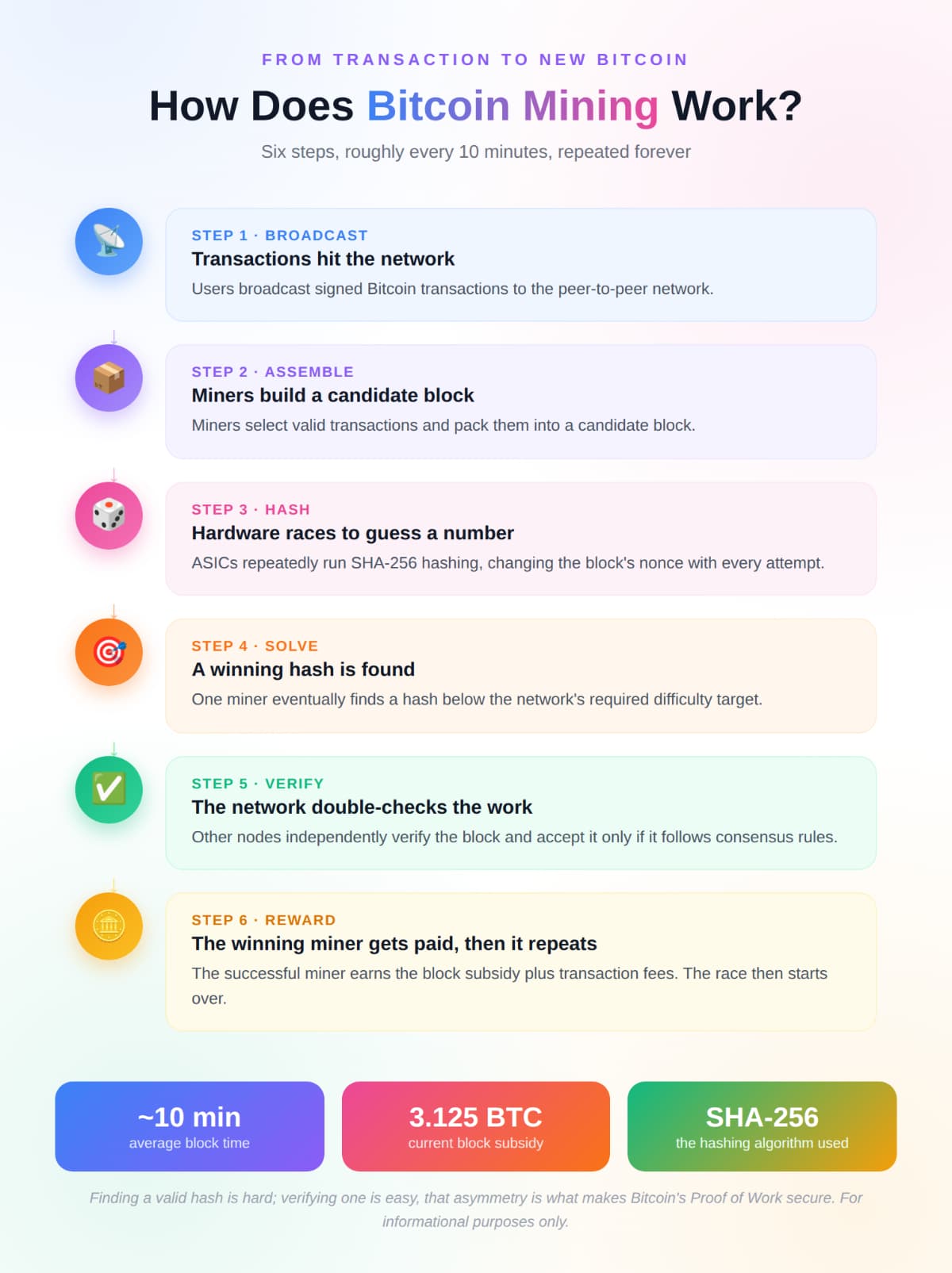
Source: Bitcoin protocol mechanics, as described in the mining process sections of this report.
Bitcoin mining has passed through several technological eras. In the beginning, ordinary CPUs were sufficient. Competition later pushed miners towards GPUs, then FPGAs, and finally specialised ASIC machines.
ASIC stands for Application-Specific Integrated Circuit. These machines are designed specifically to perform Bitcoin's SHA-256 hashing operations efficiently. Their rise transformed mining from an individual hobby into an industrial infrastructure business.
Modern mining companies operate thousands of machines and must manage power contracts, cooling, maintenance, financing, uptime, and hardware replacement cycles.
| Period | Major Development |
| 2009 | Bitcoin launches; CPU mining begins |
| 2010–2011 | GPU mining becomes popular |
| 2011–2013 | FPGA hardware gains adoption |
| 2013 onward | ASIC machines become dominant |
| 2019 | Cambridge launches CBECI for Bitcoin electricity estimates |
| 2021 | Major geographic migration follows Chinese mining restrictions |
| 2024 | Bitcoin halving reduces block subsidy to 3.125 BTC |
| 2025–2026 | Research increasingly focuses on environmental impacts, energy integration and long-term mining economics |
Bitcoin miners have two primary revenue sources: the block subsidy and transaction fees.
The block subsidy consists of newly issued bitcoin. Transaction fees are paid by users who want their transactions included in blocks. During periods of high demand for Bitcoin block space, transaction fees can become a more important component of miner revenue.
Following the April 2024 halving, the current block subsidy is 3.125 BTC. The reward is programmed to halve every 210,000 blocks, approximately every four years.
Bitcoin started with a block reward of 50 BTC. It later declined to 25 BTC, 12.5 BTC, 6.25 BTC and, after the 2024 halving, 3.125 BTC.
Halving reduces new issuance and places economic pressure on miners. Less efficient operations may become unprofitable, while miners with low-cost electricity and efficient hardware gain a competitive advantage.
Bitcoin's maximum supply is capped at 21 million coins. New issuance will continue to decline until the final fractions of bitcoin are expected to be issued around 2140. Over time, transaction fees are expected to become increasingly important to the mining economy.
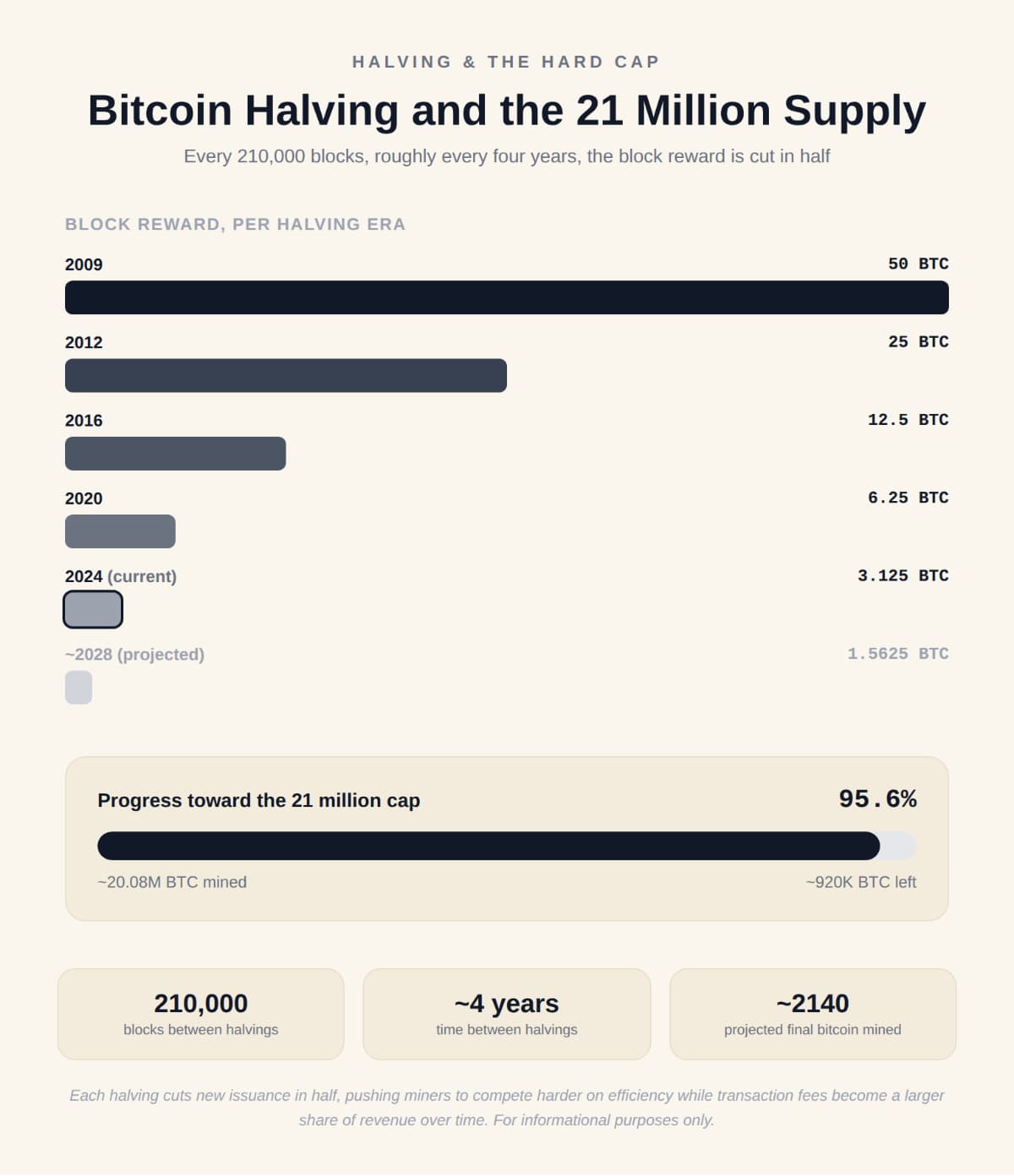
Source: Bitcoin protocol halving schedule; Bitbo.io real-time supply data, retrieved September 2026.
7. How Many Bitcoins have been Mined so far?
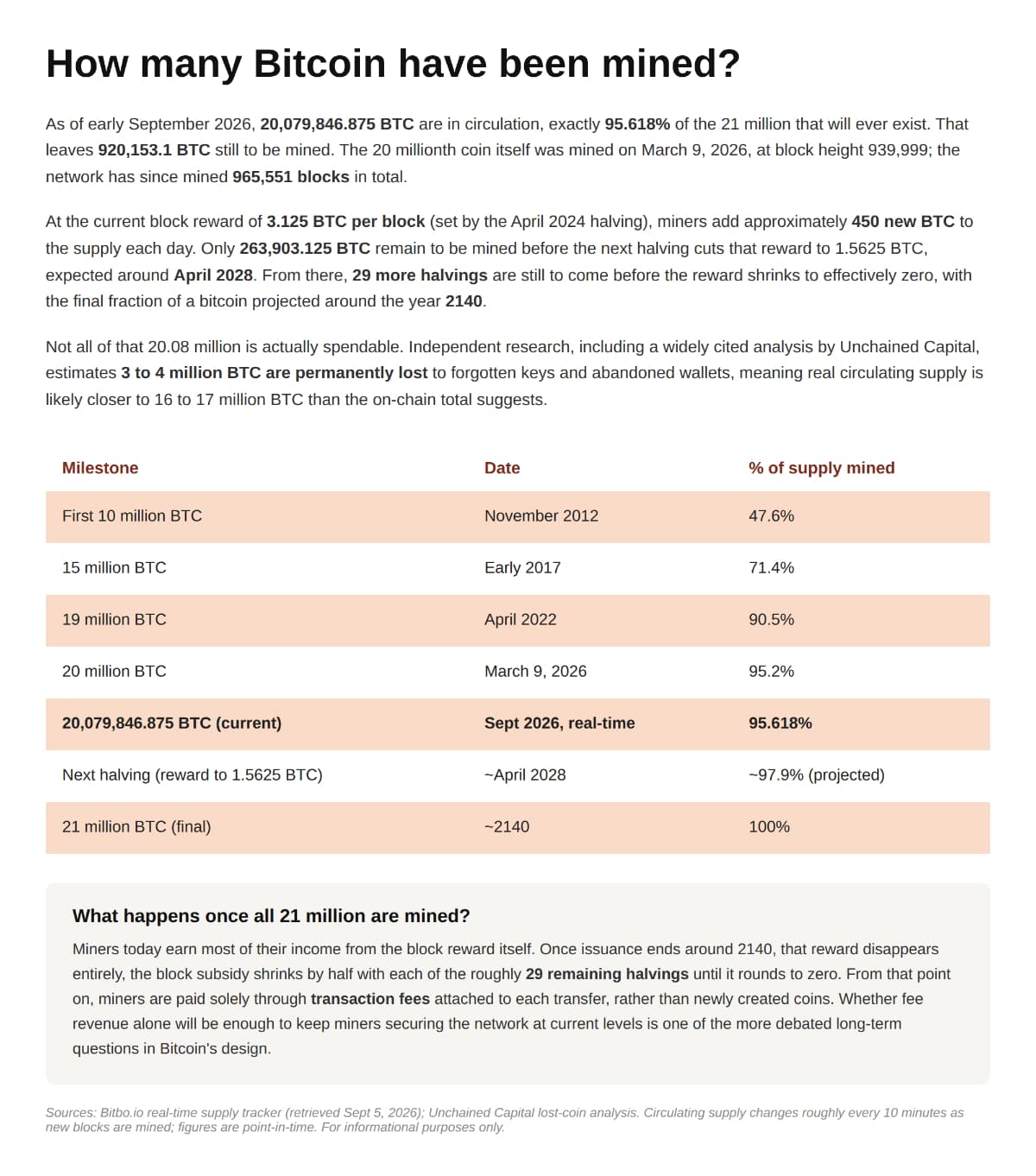
The future of mining will likely be shaped by declining block subsidies, transaction-fee economics, more efficient ASIC hardware, energy integration and increasing institutionalisation.
Each halving increases pressure on miners to reduce costs. At the same time, the long-term transition from block-subsidy revenue to transaction-fee revenue remains one of Bitcoin's most important economic questions.
Mining companies may also increasingly diversify into data centres, high-performance computing and other energy-intensive digital infrastructure.
Bitcoin mining is one of the most important and misunderstood components of the cryptocurrency ecosystem. It is the mechanism that links Bitcoin's transaction processing, monetary issuance and security model.
What began as an activity performed on ordinary computers has evolved into a global industrial sector involving specialised hardware, large-scale facilities and complex energy strategies.
The industry's future will be shaped by the economics of halving, electricity markets, technological efficiency, regulation and environmental scrutiny. The central long-term question is whether mining can continue providing sufficient economic incentives to secure the Bitcoin network as new bitcoin issuance gradually declines.
Understanding that question is essential because the future of Bitcoin mining is closely connected to the long-term security and sustainability of the Bitcoin network itself.
Sources: University of Cambridge CBECI and Cambridge Judge Business School research, Nature Communications, Scientific Reports, Cambridge research by Kufeoglu and Ozkuran, Bitcoin protocol documentation, and public company filings on mining economics and block rewards.
India Crypto Research operates independently. The information presented herein is intended solely for educational and informational purposes and should not be construed as financial advice. Before making any financial decisions, it's essential to undertake your own thorough research and analysis. If you're uncertain about any financial matters, we strongly recommend seeking guidance from an impartial financial advisor.